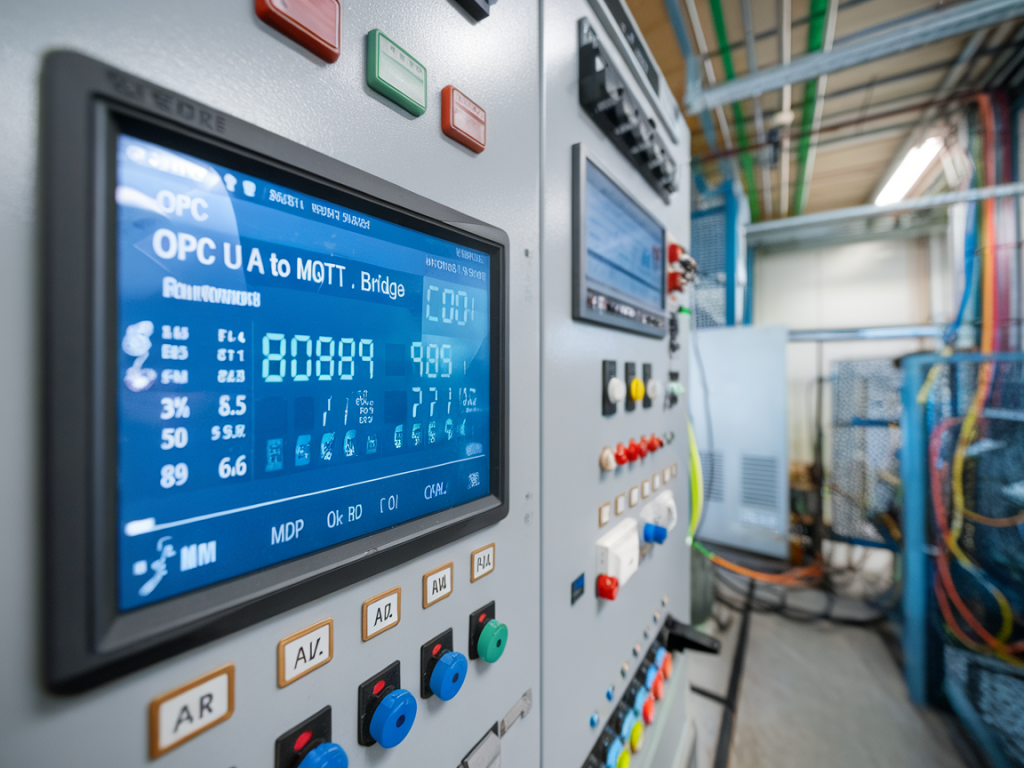
When a plant I worked with wanted to add cloud analytics and a lightweight fleet management layer to a mixed-vendor production line, they faced a familiar constraint: no one wanted to touch the existing PLC code. The reluctance was sensible — validated PLC logic, legacy support contracts, and risk-averse operations teams. The solution we validated was an OPC UA → MQTT bridge that mirrored selected tags to an MQTT broker for downstream consumers (IIoT gateway, cloud ingestion, or edge analytics). The question I get asked most is: how do you validate that such a bridge actually reduces downtime and doesn’t introduce new risk? This is the playbook I use.
Why an OPC UA → MQTT bridge is a pragmatic choice
Before testing, it’s important to be clear on trade-offs. An OPC UA → MQTT bridge can:
But it also introduces a new component that must be validated for latency, completeness, security, and operational robustness. My validation approach focuses on proving those four attributes in the context of measurable downtime reduction.
Define measurable goals up front
Validation without goals is just busywork. I always align testing with the operational KPI the plant wants to improve. Typical goals include:
Translate those goals into testable acceptance criteria. For example:
| Acceptance criterion | Target |
|---|---|
| Time from PLC bit change to MQTT publish | < 300 ms 95th percentile |
| Message delivery success rate | > 99.9% over 24 hours |
| Replay integrity (no lost samples in 1-hour burst) | 0 lost messages |
| Security posture | Mutual TLS + certificate rotation working |
Prepare a realistic test environment
Mirror production as closely as you can. I prefer a staged approach:
Key setup notes:
Validate functional correctness and data fidelity
Start with basic functional tests to confirm that every selected PLC tag is mirrored correctly:
I use automated scripts (Python + async OPC UA client and MQTT client) to replay deterministic sequences and compare values. For binary outputs and alarms, I check both state transitions and event payloads (severity, comments).
Measure latency and delivery guarantees
Latency matters for fault detection. Your bridge must meet the acceptance latency defined earlier. Do the following:
Record percentile metrics (50th, 95th, 99th) and document worst-case spikes. If your target is detection in under 1 second, a median of 50 ms with 99th percentile < 800 ms is usually acceptable in many lines.
Test resilience: network disruptions and broker failures
The real value of a validated bridge is that it reduces downtime by surviving typical failures. Key scenarios:
Practical tip: instrument the bridge to emit health metrics (connected to broker, OPC UA status, queue size). Surface these to your existing monitoring (Prometheus, Grafana) so operations can see degraded states before outages escalate.
Security and operational controls
Security is non-negotiable. Validate:
Also validate operational features: graceful shutdown, throttling, and backpressure handling. A bridge that crashes under load can cause more downtime than it prevents.
Validate the downstream consumer workflows
Reducing downtime isn’t just about moving data; it’s about enabling faster detection and action. Validate the consumers that will act on MQTT data:
I recommend A/B testing: for a period, run the bridge in parallel and compare incident detection times and resolution times against the legacy path.
Quantify downtime reduction with pilot metrics
During the pilot, track these KPIs:
Typically, I’ve seen pilots reduce detection time by 40–70% for intermittent faults that were previously visible only in historian data or required deep-dive diagnostics.
Operationalize — runbooks, monitoring, and fallbacks
Once validated, you need to lock the process in:
Training is important — operators and automation engineers must trust the new alerts. I run joint training sessions and provide cheat-sheets that explain how to interpret MQTT alerts versus SCADA alarms.
Final validation checklist
| Item | Validated |
|---|---|
| Tag fidelity (names, scales, types) | |
| Latency (95th < target) | |
| Message delivery (>=99.9%) | |
| Buffering and replay on outage | |
| Security (mTLS, ACLs, cert rotation) | |
| Auto-resubscribe & recovery | |
| Downstream consumer integration & runbooks |
Bridges like OPC UA → MQTT are powerful precisely because they let you add modern visibility and control without touching fragile PLC logic. But you only get the downtime reduction if the bridge is validated end-to-end — from timestamps in the PLC to operator action on the shop floor. My rule of thumb: validate against measurable operational KPIs, test failure modes aggressively, and make the bridge observable and manageable before you trust it to help you reduce downtime.