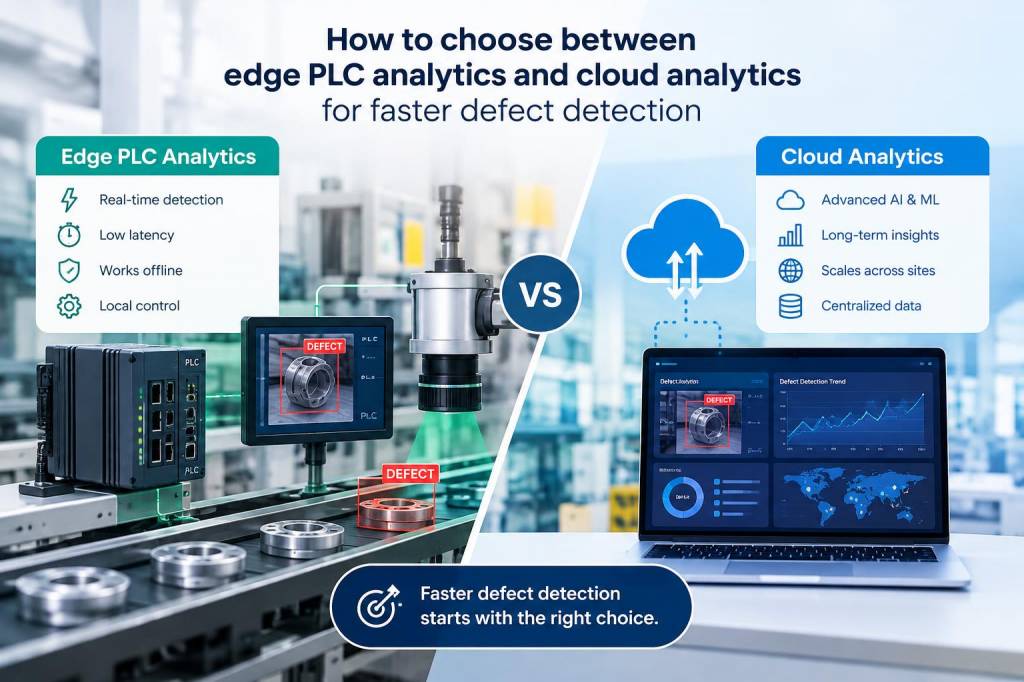
I have seen enough production lines to know that defect detection is never just a software question. It is a timing question, a data question, and often a trust question. When a part leaves a machine with a flaw, every second matters. If detection comes too late, scrap rises, rework multiplies, and operators lose confidence in alerts. That is why I spend so much time helping teams decide whether edge PLC analytics or cloud analytics will give them faster and more reliable defect detection.
My short answer is this: if your main goal is to catch defects as close as possible to the machine, edge processing usually wins. If your goal is to compare patterns across plants, build richer models, or connect quality signals to broader business systems, cloud analytics becomes very attractive. In real plants, though, I rarely see a pure choice. I usually see a layered architecture where fast detection happens near the machine and deeper analysis happens elsewhere.
What I mean by edge PLC analytics
When I talk about edge PLC analytics, I mean logic or analytics running very close to the production asset, often inside or next to a PLC, industrial PC, or edge gateway. Data is sampled, evaluated, and acted on without waiting for a round trip to a remote data center. That proximity matters when a defect can form in milliseconds.
In one electronics line I worked with, a small drift in a pick-and-place process started creating misalignment defects. A cloud-only path would have noticed the trend eventually, but not quickly enough to stop a burst of bad units. We moved a simple anomaly check to the edge, tied it to machine state, and triggered an immediate stop when the signal moved out of range. That change reduced escaped defects almost at once.
Edge analytics is strongest when you need:
What I mean by cloud analytics
Cloud analytics takes production data from machines, historians, or gateways and processes it in a centralized environment. That environment may host dashboards, data lakes, model training pipelines, and cross-site benchmarking tools. Cloud systems are excellent when the question is not just “Is this part defective right now?” but “What patterns explain defects across shifts, lines, suppliers, or plants?”
I often recommend cloud analytics when a team wants to combine quality data with maintenance records, environmental conditions, operator actions, and ERP or MES context. That broader view is hard to replicate inside a single controller. If you are trying to understand why a defect appears only after certain maintenance events or only on certain material lots, cloud analysis can reveal relationships that are invisible at machine level.
Cloud analytics is strongest when you need:
Latency is usually my first decision point
For faster defect detection, latency is not a minor detail. It is often the detail. If a defect can be prevented by stopping a process within a few milliseconds or a few scan cycles, cloud analytics may be too far away from the action. Even a strong network cannot erase physics. Transmission delay, buffering, gateway logic, and server processing add up.
That does not mean cloud is slow in a useless way. It means cloud is better for signals that can tolerate a short delay. If your process can continue safely for a few seconds while a model evaluates the data, cloud may be enough. If your process creates expensive scrap almost instantly, edge belongs in the control path.
I usually ask three questions:
If the answer to that last question is “not much,” I move the analysis closer to the PLC.
Data volume is not the same as decision speed
Many teams assume that cloud analytics is always more powerful because it can store more data. That is true in a storage sense, but not always in a response sense. A production line can generate enormous data volumes from vibration, vision systems, torque curves, temperature profiles, and force sensors. Sending all of that raw data to the cloud can create unnecessary cost and delay.
What I prefer in many plants is a filtered approach. Let the edge system inspect high-frequency data, compress it into meaningful features, and send only relevant events or summaries to the cloud. That gives you speed at the machine and scale at the enterprise level.
For example, a vision system might detect local deviations at the edge, while the cloud stores:
This arrangement protects bandwidth and keeps the control loop tight.
Model complexity changes the answer
Not every defect detection method belongs in the same place. Simple threshold logic is easy to run on a PLC. A lightweight statistical rule can also live very comfortably at the edge. More complex machine learning models may still run locally if they are optimized, but some models are better trained in the cloud and then deployed at the edge for inference.
That is one of the most practical patterns I use: train centrally, infer locally. The cloud handles model development, retraining, validation, and version control. The edge runs a compact version of the approved model for real-time decisions. This gives engineering teams a strong balance of speed and governance.
I have seen teams try to place every possible task into one layer. That usually leads to disappointment. A PLC is not a data science platform, and a cloud platform is not a real-time controller. Respecting those limits leads to better architectures and fewer surprises.
Reliability and resilience matter more than people expect
I always pay attention to what happens when the network fails. A plant does not stop being a plant because a cloud connection drops. If your defect detection depends entirely on remote processing, you may lose visibility exactly when you need it most. That is one reason I often favor edge logic for critical quality checks.
Edge analytics can keep working during outages, network congestion, or scheduled IT maintenance. Cloud analytics, by contrast, depends on connectivity and external infrastructure. That dependency is not a flaw by itself, but it must be managed. If quality protection is business critical, local autonomy is valuable.
In high-mix manufacturing, I have also found that operators trust local responses more than remote ones. If the line stops because a nearby system saw an actual fault, the event feels immediate and credible. If a remote dashboard later says a defect may have happened, the response is often weaker. Trust is a technical variable in disguise.
Security, governance, and plant politics are part of the decision
People like to talk about latency and ignore governance, but I rarely can. Edge and cloud architectures each create different security and ownership questions. Edge systems may be easier to isolate from public networks, but they multiply devices that need patching, monitoring, and lifecycle management. Cloud systems centralize management, yet they raise concerns about data residency, vendor access, and integration with corporate policy.
In many organizations, the right answer depends on who owns what. OT teams want stable local control. IT teams want standardization and visibility. Quality teams want traceability. Leadership wants measurable ROI. I have learned that a technically perfect architecture can still fail if ownership is unclear.
When I design a defect detection strategy, I try to define:
That clarity reduces friction and makes the system easier to maintain over time.
A practical comparison I use with teams
| Decision factor | Edge PLC analytics | Cloud analytics |
|---|---|---|
| Response speed | Very fast | Usually slower |
| Local autonomy | Strong | Limited |
| Historical analysis | Limited | Strong |
| Cross-site insight | Weak | Very strong |
| Deployment complexity | Moderate | Moderate to high |
| Best use case | Immediate defect prevention | Pattern discovery and optimization |
What I recommend in real manufacturing environments
If your line produces expensive scrap in seconds, start at the edge. Put fast checks close to the PLC, close to the sensor, and close to the action. Use local logic to stop the process, reject the part, or alert the operator immediately. Then send events to the cloud for analysis, reporting, and continuous improvement.
If your defect problem is complex, intermittent, or spread across multiple sites, start with cloud analytics to uncover patterns. Once you know which variables matter most, move the highest-value detection rules to the edge so the line can react faster.
In practice, I often advise a two-layer design:
This arrangement is usually stronger than choosing one side exclusively. It keeps the process safe, the data useful, and the improvement loop active.
Questions I ask before choosing a platform
Before I recommend one architecture over another, I ask a plant team a few direct questions. These questions usually reveal more than a vendor demo ever will.
Once those answers are clear, the architecture usually becomes obvious. The right choice is not always the most advanced one. It is the one that matches the timing, risk, and operating reality of the line.
Where I usually land when speed matters most
When the primary business objective is faster defect detection, I usually place the first decision at the edge and the second decision in the cloud. That means the machine reacts locally, while the organization learns globally. I like that split because it respects both production physics and enterprise intelligence.
I have learned that faster quality response comes from architecture discipline, not from chasing a single platform. A well-designed edge layer can prevent damage before it spreads. A well-designed cloud layer can help a plant understand why the problem happened and how to reduce it next time. Together, they create a stronger quality system than either one can create alone.