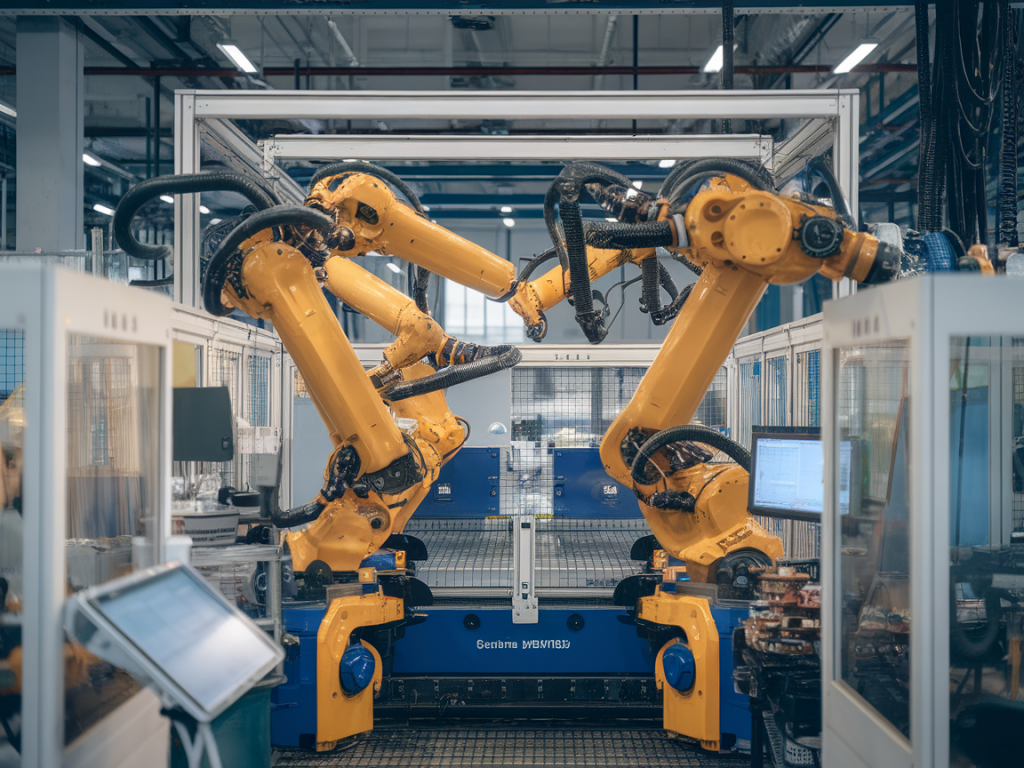
I remember the first time I watched a collaborative robot (cobot) work beside an operator on a mixed-model assembly line — it was graceful, predictable, and quietly transformative. But turning one successful pilot into ten reliable, takt‑time‑compliant stations is where the real engineering and operational discipline is tested. Below I walk through a practical pilot blueprint I’ve used with OEMs and tier‑1 suppliers to scale a cobot cell from 1 to 10 stations without breaking takt time. This is a hands‑on, no‑fluff guide: metrics to watch, decisions to make, common failure modes, and a checklist you can use in the next 90 days.
Start with the right takt and acceptance criteria
Everything hinges on a clear, shared definition of takt time and acceptance criteria for the pilot. If your takt is 45 seconds per unit, the cell — including handoffs, fixtures, and auxiliary tasks — must reliably meet that across the production shift, not just in a short test window.
Define and document:
Cycle time target: the maximum time the cobot station may consume per unit (including robot motion, human interaction, and tool change).Availability target: target uptime percentage for the cell (I usually set ≥ 92% for pilot acceptance).Quality target: defect rate introduced by the station (often ≤0.5% depending on product).Repeatability & variation: acceptable standard deviation on cycle time (e.g., < 1.5 s).Design the pilot cell with scale in mind
When I design a 1‑station pilot that must scale to 10, I treat the pilot as a “replicable module.” That means the mechanical footprint, fixturing approach, HMI layout, tool interfaces, and network architecture should all be modular and cheap to copy.
Modular fixtures: design jigs that locate parts by datum and can be clamped and unclamped quickly. Avoid bespoke fixtures for the pilot that can’t be economically reproduced.Standardized tooling & EOAT: use end‑of‑arm tooling (EOAT) and grippers that are commercially available and easy to mount (e.g., Robotiq, OnRobot).Repeatable human interface: keep the operator station ergonomics consistent — height, reach, display placement — across every cell.Electrical & pneumatic pod: design a single power/data/pneumatic pod per station so later replication is plug‑and‑play.Control, safety, and IT stack
Don’t bolt on enterprise IT as an afterthought. From day one, ensure the cell’s control and data architecture will support rapid replication.
Local PLC or compact controller: keep the station control logic near the cell for deterministic interlocks and safety. A compact PLC paired with the cobot controller works well.Edge gateway: use an edge device (Siemens Industrial Edge, Hilscher, or a small industrial PC) to aggregate events, KPIs, and logs. Make sure the gateway supports MQTT/OPC UA and time synchronization (NTP/PPS).Standard comms schema: define a minimal data model for part ID, cycle start/stop, status codes, and quality flags. Use the same topic/OPC node names across all stations.Safety framework: integrate safety rated devices (e.g., light curtains, safety mats) where needed, but prefer collaborative mode with proper risk assessment for true human‑robot workshare. Document the safety case for replication.Pilot execution: metrics, tests, and runbook
Run the pilot with a structured test plan that stresses real production variability. I run three phases: dry runs, production shadow, and live production. Each has defined success gates.
Dry runs (3 shifts): validate cycle time under controlled variability (fixture changes, part tolerances). Collect per‑cycle timestamps.Production shadow (5 shifts): have the station process the live line flow but route parts to a holding area. Measure takt compliance under shift changes and material supply fluctuations.Live production (10 shifts): full production, monitored closely with immediate rollback criteria defined.Key metrics to capture continuously:
| Metric | Target | Why it matters |
| Cycle time (mean ± sd) | ≤ takt, sd < 1.5 s | Ensures takt compliance and stability |
| Availability | ≥ 92% | Reflects downtime and maintenance impact |
| First pass yield | ≥ target (e.g., 99.5%) | Quality impact of station |
| Changeover time | ≤ defined limit | Essential for mixed‑model lines |
Replication playbook — how to scale from 1 to 10
Scaling is less about buying more robots and more about systematizing variability and installation work. Here’s the playbook I use.
1. Lock the module design: freeze mechanical drawings, fixture part numbers, cable lists, and PLC logic. Treat this as a versioned artifact.2. Create a replication kit: a single box containing the full BOM, test scripts, safety checklist, and a 2‑page commissioning checklist.3. Train a commissioning squad: 2–3 technicians who know the module end‑to‑end. During scale‑up, this squad becomes a production team.4. Pilot multiple at once: install stations in small batches (2–3) to expose cross‑station interactions — material flow, buffer management, and shared utilities.5. Instrument the learning loop: capture every issue as a ticket (why, severity, fix), categorize by mechanical, electrical, software, or human factor, and rotate fixes back into the module design.Common pitfalls and how to avoid them
From dozens of pilots, a few failure modes recur:
Underestimating material supply: cobots are fast — if feeders, kitting, or conveyors aren’t sized, the entire station stalls. Solution: simulate MRP/kanban buffer sizes for 10 stations before install.Hidden variability in parts: small tolerances, burrs, or coating differences disrupt grippers. Solution: run a parts variability study and design EOAT with low sensitivity or vision correction (e.g., Cognex, Keyence).Poor comms standardization: different PLC tags and topic names double commissioning time. Solution: enforce the data model and provide a mapping template to IT teams.Operator inconsistency: different operators adopt different habits that affect cycle time. Solution: standardized training, on‑machine prompts, and poka‑yoke fixtures.KPIs to watch during scale
As you approach 10 stations, shift focus from single‑cell metrics to system metrics:
Line throughput vs target: end‑to‑end units per hour compared to planned output.Aggregate OEE of the 10 cells: visibility into whether downtime is localized or systemic.Mean time to repair (MTTR) and mean time between failures (MTBF): track whether scale introduces maintenance bottlenecks.Labor delta: actual FTE change post‑automation vs budget.Operationalizing continuous improvement
Once the ten stations are live, turn operational excellence into a rhythm. I recommend weekly data reviews for the first quarter, then bi‑weekly. Use the data model to feed dashboards and set specific improvement experiments: faster tool paths, optimized hold times, or better feed systems. Small incremental changes will keep takt intact while driving yield and availability improvements.
Scaling cobots is both a technical and organizational challenge. If you treat each station as a reproducible module, instrument everything, and maintain a tight feedback loop between the shop floor and engineering, you can expand from a single successful pilot to ten seamless, takt‑compliant stations without surprising your production targets — and with a clear path to scale beyond.