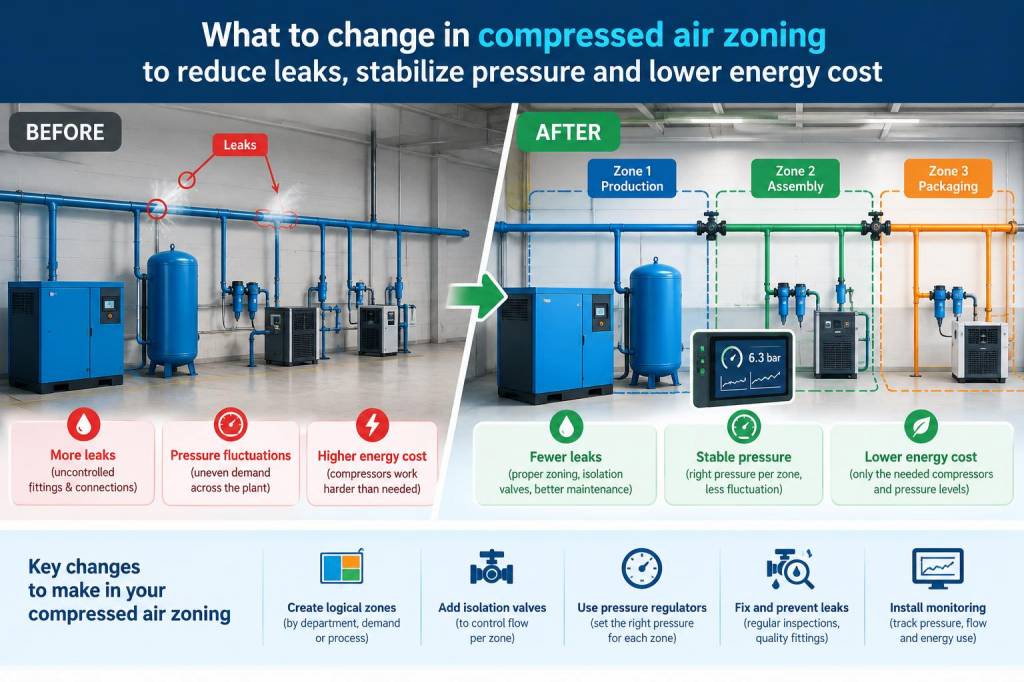
Compressed air can become one of a plant’s quietest energy drains, and zoning is often where I see the biggest opportunity for improvement. When I walk a facility and hear constant hissing, watch pressure swings at distant points, or see compressors running harder than production really needs, I know zoning is usually part of the story. A compressed-air network should not behave like one giant undivided system. It should behave like a set of purpose-built zones, each one matched to real demand, real risk, and real operating conditions.
What I change first is not always the compressor itself. I start with air distribution logic. Many plants inherited a layout that was built for convenience, not efficiency. A single header feeds every area, every shift, and every machine family, even when demand patterns are very different. That kind of arrangement makes leaks harder to isolate, pressure harder to control, and energy cost harder to predict. When I rework zoning, I aim to make each zone smaller, more accountable, and easier to manage.
Why zone design matters more than many teams realize
In a poorly zoned system, one small leak or one temporary demand spike can affect an entire plant. Pressure drops travel fast through a shared network, so operators raise setpoints to protect remote equipment. That response feels harmless, but it creates a chain reaction: higher pressure increases leak rate, increased leak rate increases compressor run time, and longer run time increases electricity cost. I have seen teams chase symptoms for months when the real issue was zone structure.
Good zoning changes that dynamic. It lets me separate stable loads from variable ones, isolate high-consumption areas, and prevent one process from forcing every other process to pay for it. A packaging line with frequent cycling does not need to drag down pressure for a steady assembly area. A maintenance shop with intermittent use should not sit on the same unmetered branch as critical production equipment. Once I divide demand into clear groups, I can size controls, storage, and monitoring around actual behavior rather than guesswork.
What I change in a compressed-air zone layout
I usually begin by identifying which areas truly need plant air and which areas could be separated, switched off, or supplied with a different pressure band. Many facilities overuse compressed air because it is convenient, not because it is technically necessary. I look for these changes first:
- Separate production areas with different duty cycles.
- Isolate intermittent users from continuous users.
- Keep critical equipment on a more stable branch with dedicated control.
- Remove nonessential loads from central distribution.
- Place shutoff valves and pressure sensors at zone boundaries.
That last point is especially important. If I cannot measure a zone, I cannot manage it. I want each major zone to have a pressure reading, a flow signal if possible, and a clear isolation method. Without that visibility, leaks blend into background noise and pressure control becomes reactive instead of proactive. I also prefer zone-level metering because it helps me prove which area is wasting air and which area is performing well.
Another change I often make is to split a long, undersized loop into a more intentional ring or branch design. Old distribution systems often create hidden bottlenecks. A line may look generous on a drawing, but elbows, filters, dryers, aging couplings, and corroded pipe can create unexpected resistance. When a zone is too long or too complex, pressure loss grows and operators compensate by setting a higher discharge pressure. If I can shorten the path, simplify the route, or add a local storage receiver near demand, I usually gain stability without adding much complexity.
Leak control becomes easier when zones are smaller
Leaks are not only a maintenance problem; they are a zoning problem. In a large shared network, one leak can hide inside a forest of small losses. In a better zoned system, I can narrow the search immediately. If one zone shows abnormal overnight flow, I know where to send a technician before wasting time scanning the whole plant.
I have also found that smaller zones change behavior. When operators know a zone is monitored, they tend to report issues faster and leave manual valves in a more sensible state. Accountability improves. Air left on at a bench, a tool left connected after a shift, or a solenoid that stays energized overnight becomes easier to spot. In practice, zoning turns leaks from a vague plant problem into a local issue with a clear owner.
For plants that cannot rebuild piping right away, I still recommend temporary zoning using isolation valves, branch metering, and clear operating rules. Even a partial separation can reduce waste quickly. If a nonproduction area can be shut off after hours, that single change often produces a visible drop in consumption within days.
Pressure stability depends on demand separation
Stable pressure is not just a comfort issue. It affects machine performance, part quality, cycle time, and downstream reliability. I have seen pneumatic actuators misbehave, blow-off nozzles lose effectiveness, and control valves respond inconsistently simply because network pressure fluctuated too much. When pressure swings, operators often raise setpoints as a buffer, but that is an expensive fix.
Instead, I try to separate zones by sensitivity. A zone with critical controls deserves a more stable supply and perhaps local storage. A zone with large but brief demand spikes may need a receiver close to the load so the compressor does not react to every short burst. A zone with highly variable use may benefit from a dedicated pressure regulator and tighter scheduling. This is where zoning becomes more than pipe arrangement; it becomes a control strategy.
I also pay attention to pressure cascades. If one area is set too high, it can mask problems elsewhere and create unnecessary consumption. I prefer to lower pressure only after I confirm that each zone has enough local capacity and that any high-demand equipment is truly justified. In my experience, plants often discover that they were running several zones at elevated pressure just to satisfy one problematic branch. Once that branch is fixed or isolated, the whole system can step down.
Energy cost falls when pressure targets become specific
Compressed-air energy cost is heavily influenced by pressure. A small reduction can create meaningful savings, especially when the system runs many hours per year. That is why I want zone-specific pressure targets instead of one blanket target for every department. If one area needs 7 bar and another can run at 6 bar, I do not want both areas forced to live at 7 bar unless there is a real technical reason.
To make that work, I usually change three things at once: distribution, control, and operating discipline. Distribution becomes shorter and more selective. Control becomes local enough to respond to actual demand. Operating discipline becomes clearer because each zone has a defined target and defined shutoff practice. When all three align, I usually see lower compressor load, fewer starts and stops, and less wasted energy at low-demand times.
| Zone issue | Common symptom | Change I usually make | Expected effect |
|---|---|---|---|
| Shared high-demand branch | Pressure dips during peaks | Add local storage and separate control | More stable supply |
| Long distribution path | Remote machines lose pressure | Shorten route or create closer feed | Lower pressure loss |
| Mixed duty cycles | Compressor runs too often | Split intermittent loads from steady loads | Less unnecessary cycling |
| Poor visibility | Leaks stay hidden | Add zone metering and isolation points | Faster leak detection |
What I look for during a zoning review
When I review a plant, I ask a few practical questions. Which areas run continuously? Which areas shut down at lunch, between shifts, or on weekends? Which machines are sensitive to pressure variation? Which zones have frequent maintenance access? Which branches have old fittings, quick-connects, or temporary hoses that should not be permanent? Those answers usually reveal where zoning should change first.
I also pay attention to human behavior. If operators routinely open local drains, bypass regulators, or leave blow guns connected, zoning alone will not solve the issue. But better zoning makes those habits visible. Once each area has its own boundaries and data, managers can see patterns instead of guessing. That makes corrective action far more effective.
In many projects, I start with a simple measurement campaign: flow at the main header, pressure at key branches, and overnight profile by zone. Even a short baseline often exposes the worst offenders. If one branch shows demand when no one should be working, I know I have a control or leak problem. If another branch shows repeated pressure collapse during machine starts, I know the zone needs storage or separation.
Practical changes that usually deliver quick value
Some changes are structural, and others are operational. I like to combine both. The structural changes improve long-term performance, while the operational changes produce faster savings. In many plants, a few disciplined actions can create immediate benefit:
- Close off unused branches and dead legs.
- Install shutoff valves for after-hours isolation.
- Add pressure and flow measurement at major zone boundaries.
- Move high-variation users onto separate supply branches.
- Use local storage near intermittent demand.
- Lower target pressure only after confirming zone stability.
These changes may sound basic, but they are often missing. I have seen facilities invest in a new compressor while leaving a poor zoning structure untouched. That approach can work for a while, but it usually treats symptoms instead of root causes. If I can make the zones behave better, I can often delay capital spending and still improve reliability.
What I would not do anymore
I would not keep every department tied to one undifferentiated pressure network if I had any choice. I would not rely only on compressor controls to solve distribution problems. I would not assume that a single pressure setting is safe for every machine. And I would not ignore leak patterns just because overall production still seems normal. Those habits hide cost and make future improvements harder.
What I do instead is treat compressed air like a managed utility with distinct service areas. That mindset changes everything. Once a plant stops seeing air as one invisible stream and starts seeing it as a set of controlled zones, leaks become easier to localize, pressure becomes easier to stabilize, and energy cost becomes easier to reduce in a measurable way.