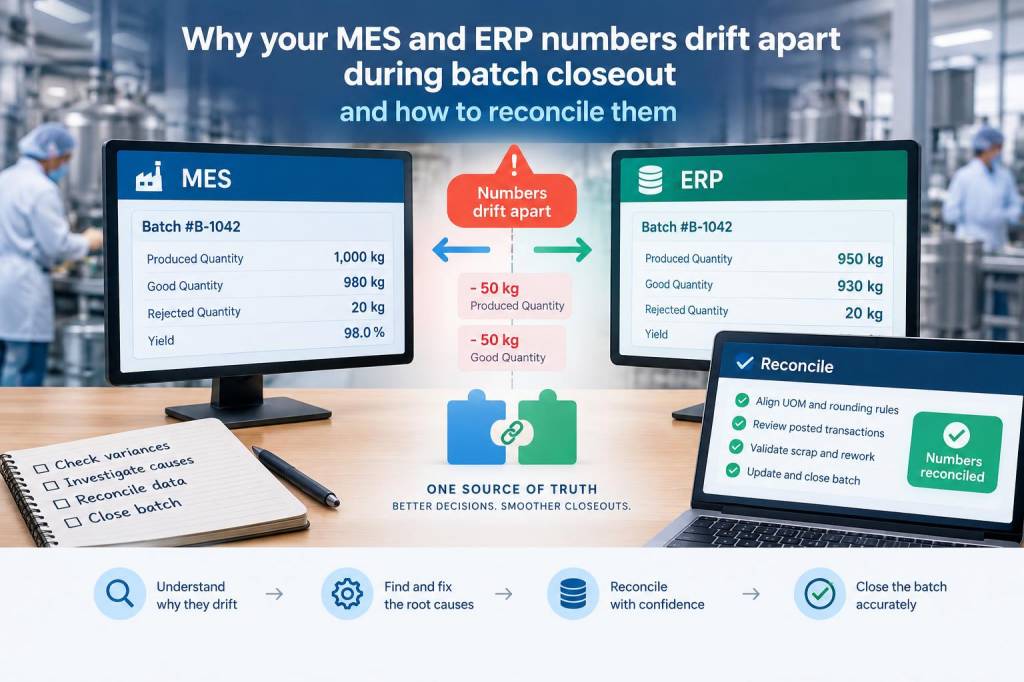
I have seen this problem in plant after plant: MES shows one finished quantity, ERP shows another, and both systems insist they are right. During batch closeout, that mismatch can feel small at first, but it quickly becomes a reporting problem, a finance problem, and sometimes a compliance problem. What makes it especially frustrating is that people often assume there is a single root cause. In practice, I usually find a chain of small differences that stack up until numbers drift apart enough to trigger questions from production, quality, and accounting.
When I work through a closeout discrepancy, I start by treating MES and ERP as different lenses on one physical event. MES captures execution in real time, often at a more granular level. ERP records business transactions, often after validation, approval, or aggregation. That difference alone can create apparent gaps. Add manual adjustments, timing delays, rework, scrap rules, partial consumption, and lot genealogy decisions, and you get two versions of reality that no longer line up cleanly.
Why closeout drift happens in day-to-day operations
Batch closeout is rarely a single click. It is a sequence of events: production ends, quantities are confirmed, quality results are reviewed, materials are reconciled, and financial postings are released. If any step uses different assumptions, numbers drift apart. I usually see drift in one of five places.
- Timing differences: MES closes a batch at line stop, while ERP posts at shift end, day end, or after approval.
- Unit conversion errors: one system stores kilograms, another stores pounds, and rounding rules are not identical.
- Scrap and yield logic: MES records actual losses at operation level, while ERP applies standard loss factors or separate scrap postings.
- Backflushing variance: component consumption in ERP is based on standard quantities, but MES records actual usage from equipment or operators.
- Manual edits: a supervisor corrects a count in one system without making the matching update in the other.
I have also seen drift caused by seemingly harmless interface rules. For example, an integration may round every decimal quantity to two places before sending it to ERP. That sounds minor until you multiply it across repeated batches, partial packs, or high-volume ingredient transfers. By closeout, the difference is no longer minor at all.
Where MES and ERP usually disagree
In my experience, the biggest misunderstanding comes from expecting both systems to answer the same question. MES often answers, “What happened on the floor?” ERP answers, “What should be financially recognized?” Those are related, but not identical.
MES may capture:
- Actual machine run time
- Operator-confirmed good output
- Scrap by cause code
- Rework routed to another step
- Micro-stoppages and short interruptions
ERP may capture:
- Confirmed production quantity
- Inventory issue and receipt postings
- Standard cost absorption
- Batch status changes
- Financial close controls
Those differences matter because closeout often requires a translation between operational truth and financial truth. If that translation is not explicit, every department invents its own version. Production trusts the line report, finance trusts the posting log, and quality trusts the lot disposition. Nobody is wrong, yet nobody matches.
My usual reconciliation method
When I need to reconcile drifting numbers, I avoid jumping straight into the interface logs. I start with a simple question: what quantity should be considered authoritative at each step of the batch lifecycle? I define the source of truth for each event, not for the whole process. That distinction helps a lot.
I normally map the batch into checkpoints:
- Material issue
- Actual production start
- Intermediate yields
- Scrap creation
- Rework movement
- Finished goods declaration
- Quality release
- ERP posting
Then I compare MES and ERP at each checkpoint instead of only at closeout. This reveals where the divergence begins. In many cases, the first mismatch appears long before final posting. Once I find that first break, I can usually trace the cause to one of a small set of issues: delayed interface jobs, duplicate transactions, missing status changes, or manual override behavior.
I also like to compare not only quantities, but transaction timestamps, user actions, and status history. A quantity mismatch with matching time stamps often points to a logic issue. A quantity mismatch with a late ERP timestamp often points to a delay or backlog. A mismatch that appears only after manual intervention often points to process discipline, not system design.
What I check first when numbers do not match
When I am on site or reviewing a case remotely, I move through the same set of checks because they usually expose the real problem faster than a broad audit.
| Check | What I look for | Why it matters |
|---|---|---|
| Time alignment | Batch end, shift cut, job close, interface send time | Different clocks create false mismatches |
| Unit logic | Mass, count, volume, rounding rules, conversion factors | Small conversion gaps can accumulate |
| Status logic | Closed, released, blocked, reversed, reopened | A record may be visible in one system but not postable in another |
| Scrap treatment | Where scrap is booked and when | Scrap can reduce yield in MES while remaining invisible in ERP |
| Rework handling | Separate order, same order, or inventory transfer | Rework often creates double counting or missing quantity |
| Interface retries | Duplicate sends after failure | Retries can create duplicate postings if idempotency is weak |
One lesson I learned early is that a clean interface does not guarantee clean business logic. I have seen technically successful integrations that still produced bad reconciliations because each system used a different rule for partial completion. A batch could be 99.8 percent complete in MES and still be forced to 100 percent in ERP for posting. That kind of rule can be acceptable if it is documented and expected. It becomes a problem when nobody remembers it during closeout.
Batch closeout problems I see in mixed discrete and process environments
Batch environments introduce complications that are less common in simple discrete assembly. Ingredient variance, potency adjustments, blend losses, and sampling deductions all matter. If ERP is built around standard BOM assumptions while MES records actual process conditions, the gap can widen quickly.
I have worked with plants where a single batch was consumed across multiple tanks, held for lab approval, and then split into several finished lots. In those cases, a one-to-one reconciliation is impossible. The only workable approach is lot genealogy with explicit transformation rules. Without that structure, people try to match one finished quantity in ERP to one physical batch in MES, and the result is endless debate.
Another common issue is split posting. MES may release output in several steps as each vessel or line completes, while ERP expects one final receipt. If the intermediate postings are not aggregated correctly, the batch appears underreported in one system and overreported in another until the last transaction lands. That temporary gap often looks like a system error, even though it is really a sequence design issue.
Process controls that reduce drift
I do not rely on reconciliation reports alone. I prefer controls that prevent drift from building in the first place. In practice, that means making the business rules explicit and enforcing them consistently across both systems.
- Use one common batch identifier across MES, ERP, and quality systems.
- Define which event closes production, which event closes inventory, and which event closes finance.
- Align unit of measure rules and rounding behavior before go-live.
- Make scrap, rework, and yield adjustments visible in both systems with matching codes.
- Set interface monitoring that flags late, duplicate, or rejected transactions immediately.
- Require exception approval for manual overrides and record every change with user, time, and reason.
I also recommend periodic reconciliation drills, not just month-end firefighting. A weekly sample of batches is often enough to reveal a pattern before it becomes a closeout crisis. If I can compare a few representative batches by product family, line, and shift, I usually spot the weak point in the workflow much earlier than if I wait for a finance review.
What makes reconciliation reliable instead of cosmetic
A lot of reconciliation efforts fail because they only force numbers to match without fixing the cause. That may satisfy a report, but it does not improve process control. I want reconciliation to answer three questions: where did the difference start, which rule created it, and which system should own the correction.
That is why I often separate operational correction from financial correction. If the issue is a missed scrap event, I fix the transaction model and make sure the floor process captures it correctly next time. If the issue is a timing delay, I review interface scheduling and posting windows. If the issue is a legitimate estimate-versus-actual difference, I document the rule so everyone understands why the systems differ for a period of time before final settlement.
When people ask me what success looks like, I do not say “perfectly matching reports every time.” I say predictable variance, documented exceptions, and fast root-cause resolution. In a real plant, some drift will always exist because operations, quality, and finance do not observe reality from the same angle. My goal is to make that drift small, explainable, and easy to reconcile before it spreads into inventory distortion, delayed closeout, or management confusion.
I have found that once a team starts treating MES and ERP as complementary records rather than competing records, the conversation changes completely. Instead of arguing over which number is right, people start asking which event was missed, which rule was applied, and which workflow needs to change. That is where reconciliation becomes useful, because it stops being a monthly cleanup task and becomes part of process design.