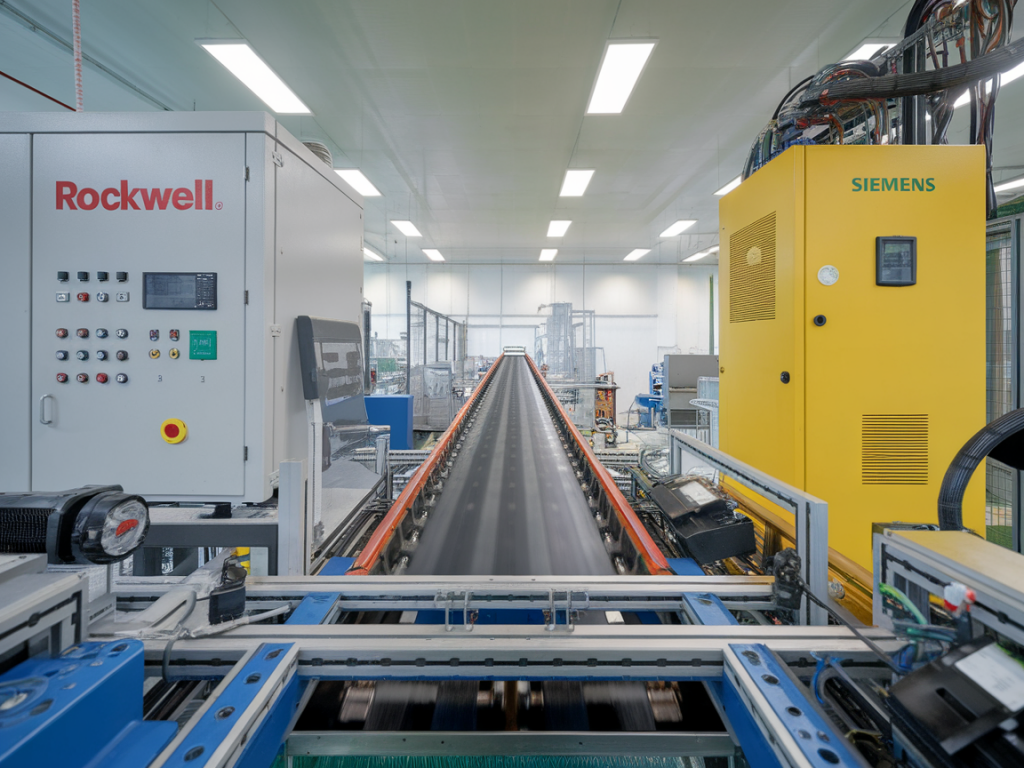
I’ve designed and commissioned mid‑scale conveyor systems for automotive tier suppliers, food packaging lines, and electronics assembly plants. One of the most common questions I hear from engineers and plant managers is: Which control platform should we standardize on — Rockwell, Siemens, or Beckhoff? The short answer is: it depends. The longer answer — which follows — walks through the practical tradeoffs I use when advising clients. I’ll share what matters in the field, the pitfalls I’ve seen, and specific scenarios where one platform tends to win over the others.
What I mean by “mid‑scale conveyor automation”
For this article, I define mid‑scale conveyors as systems that are larger than a single machine cell but smaller than full‑plant logistics: multiple conveyor lines, accumulation, sortation, indexing stations, basic indexing or servo sections, a handful of high‑speed transfer points, and interactions with PLC‑level I/O and MES. Typical channel counts range from a few hundred to low thousands of I/O points, several servo axes, and soft real‑time coordination requirements.
Primary decision criteria I use on projects
When I evaluate platforms I focus on criteria that matter for delivering predictable ROI on the shop floor:
Engineering skillset and vendor ecosystem — who can commission and support the setup quickly?Deterministic motion and communication — does the platform meet your timing needs (e.g., coordinated servo, high‑speed I/O)?Scalability & future integrations — will it handle expansions, MES/ERP and cloud data needs?Total cost of ownership (TCO) — hardware, software licensing, engineering time, spare parts and lifecycle risks.Openness and standards — network protocols (EtherCAT, PROFINET, EtherNet/IP), OPC UA support, and third‑party device interoperability.Functional fit for conveyor features — built‑in supports for accumulation control, zone management, and line sequencing.Rockwell Automation — when it’s the right choice
Rockwell (ControlLogix/Studio 5000, CompactLogix) is often the safe default in North America. I recommend Rockwell when:
Your operations are already standardized on Allen‑Bradley hardware and you have local integrators certified in Studio 5000.You require tight support from a local vendor network and prefer a single‑vendor stack for PLC, safety, and HMI.Your conveyor needs integrate tightly with Rockwell‑centric MES or material handling packages that use EtherNet/IP.Strengths I’ve observed:
Excellent local support and large installed base of electricians and integrators in the Americas.Studio 5000 provides a familiar engineering environment for ladder and structured text programmers.High reliability in standard PLC tasks and solid safety and motion options with integrated safety controllers.Limitations to watch for:
Higher licensing and module costs relative to some competitors, especially for small runtimes.Less native support for EtherCAT; Rockwell favors EtherNet/IP which is great for Allen‑Bradley ecosystems but can complicate integrating third‑party drives/providers that prefer EtherCAT.Proprietary tendencies — integrating open software or non‑Rockwell motion libraries can increase engineering effort.Siemens — when it’s the right choice
Siemens (S7 / TIA Portal, SINAMICS drives) is a strong contender especially for European sites and projects that need robust networking and industrial standards. I pick Siemens when:
The plant uses other Siemens systems (motors, drives, SCADA) or is in Europe/APAC where Siemens support density is high.Complex machine‑level sequencing and modular automation patterns are required across multiple lines.There’s strong use of PROFINET/PROFIBUS and a desire to rely on established industrial communication standards.Strengths I’ve observed:
Very mature hardware and diagnostics for large distributed I/O sets; excellent tooling in TIA Portal for device mapping and diagnostics.Good motion control ecosystem (SIMOTION/SINAMICS) for synchronized conveyors and transfer systems.Strong support for electronic nameplate and device replacement strategies that reduce downtime during rollovers.Limitations to watch for:
Softer coverage of EtherCAT in older Siemens stacks (though Siemens has improved flexibility with recent offerings).Engineering learning curve if your staff is not experienced with TIA Portal and Siemens naming conventions.Cost of spare modules and the typical enterprise licensing model that can feel heavy for smaller integrators.Beckhoff — when it’s the right choice
Beckhoff champions PC‑based control and EtherCAT. I recommend Beckhoff when:
High‑speed, highly coordinated motion (e.g., multi‑axis transfer systems, linear motor conveyors, or web handling) is a requirement.You want a modular, open architecture with a small hardware footprint and the ability to run deterministic control on standard PC hardware.Openness (IEC 61131‑3 via TwinCAT, OPC UA, MQTT) and custom software integration (vision, AI inference at the edge) are important.Strengths I’ve observed:
EtherCAT provides excellent determinism and low latency — ideal for tightly synchronized zones and servo networks.TwinCAT supports multiple paradigms (structured text, real‑time C#, MATLAB/Simulink workflows) which is great for advanced control engineers.Lower hardware entry cost and strong third‑party device interoperability via open protocols.Limitations to watch for:
Smaller pool of field technicians comfortable with PC‑based control compared with PLCs in some regions.Reliance on commercial PC hardware demands attention to industrial PC selection and lifecycle — bad PC choices can cause field headaches.Less straightforward for teams that prefer ladder logic or a traditional PLC mindset.Quick feature comparison
| Criteria | Rockwell | Siemens | Beckhoff |
| Best regions | North America | Europe, APAC | Global (niche motion/PC‑control) |
| Primary protocol | EtherNet/IP | PROFINET/PROFIBUS | EtherCAT |
| Motion determinism | Good | Very Good | Excellent |
| Openness | Moderate | Moderate | High |
| Typical TCO | Higher upfront | Medium‑high | Competitive |
Questions I always ask clients
Before choosing a platform, I run through a short checklist to avoid surprises on the shop floor:
What is the existing automation standard across the plant or group? Sticking with that reduces spare inventory and training needs.Do you need sub‑millisecond coordination between axes or can you tolerate typical PLC scan‑based synchronization?Who will maintain the system? In‑house electrical technicians, local integrator, or OEM service contract?What higher‑level integrations are required (MES, WMS, ERP, cloud telemetry)? Which protocols do those systems support?What is the expected lifecycle and expansion plan over 3–7 years?Practical recommendations by scenario
If you need quick guidance, here are my pragmatic recommendations from real projects:
Standardize on Rockwell if you operate in North America, have many Allen‑Bradley systems already, and want predictable local support.Choose Siemens when you are in Europe/APAC, need enterprise‑grade device management and PROFINET fits your ecosystem.Go Beckhoff when servo coordination, EtherCAT, openness for custom software, or cost‑effective distributed IO are top priorities.Finally, remember that hybrid architectures are common: Rockwell PLCs for machine safety and line orchestration, Beckhoff motion controllers for a high‑speed transfer module, and Siemens drives for heavy DC motors. I’ve architected systems where each vendor’s strengths were used where they mattered most — but the integration cost must be accounted for.
If you’d like, I can help you map these options to your specific conveyor layout, I/O count, and long‑term roadmap — share a PLC‑level I/O list or a single‑line diagram and I’ll sketch a recommended architecture and high‑level cost drivers.