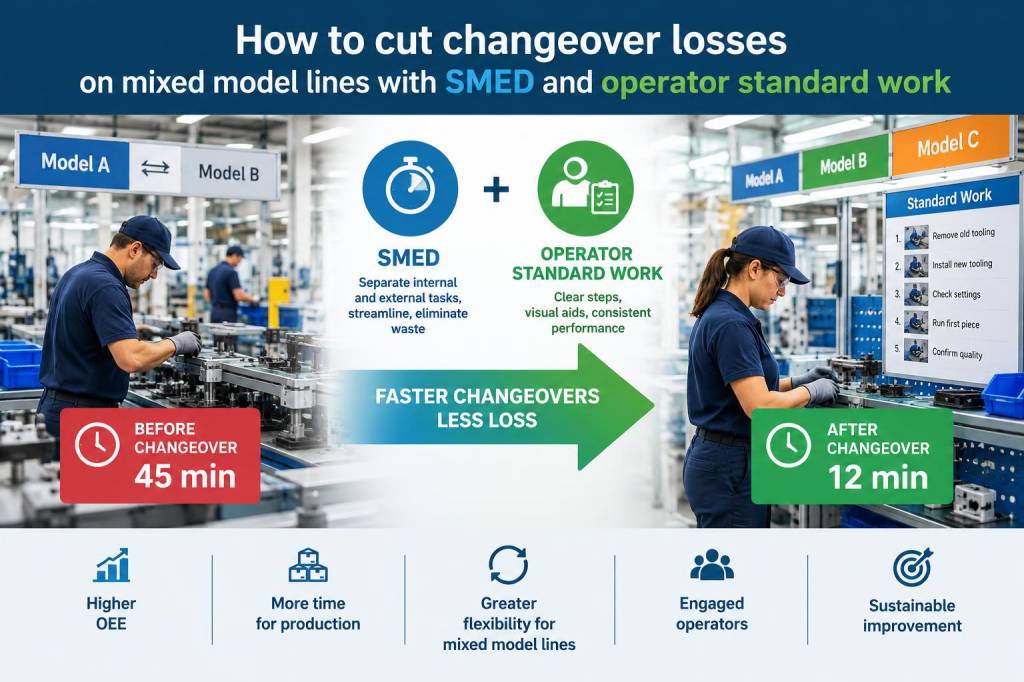
Mixed-model lines can look efficient on a dashboard and still bleed time at every changeover. I have seen lines that ran at excellent nominal speed yet lost more capacity to setup, adjustment, part staging, label changes, and first-piece approval than to actual breakdowns. In many plants, changeover losses are accepted as a fact of life. I do not accept that. When I work on this problem, I treat it as a combination of method loss, motion loss, waiting loss, and decision loss. SMED and operator standard work are powerful because they attack all four at once.
What makes mixed-model lines especially difficult is variation. A line may switch between product families every few minutes or every few hours, and each mix creates a different setup burden. One product needs a nozzle swap, another needs a recipe change, another needs a torque tool adjustment, and another needs a packaging format change. If those tasks live only in people’s heads, every changeover becomes a small experiment. I prefer to make changeover a repeatable process with clear externalized steps, visual controls, and a standard sequence that any trained operator can follow with confidence.
Why changeover loss grows so fast on mixed-model lines
On a mixed-model line, changeover loss rarely comes from one large problem. It accumulates through dozens of small delays. An operator walks to find a tool. A pallet is not ready. A parameter sheet is outdated. Quality waits for a first-off check. Maintenance is called because a fixture is sticking. Each delay may look minor, but together they can destroy line availability and create frustration for everyone involved.
I usually start by separating losses into visible and hidden categories. Visible losses are easy to see on a stopwatch: machine stop, tool exchange, cleaning, and restart. Hidden losses are more damaging because they are normalized. Examples include extra searching, unclear ownership, duplicate approvals, missing parts, and inconsistent startup checks. SMED works well because it forces me to classify every activity as either internal or external. Operator standard work then locks the improved method into daily practice so the gains do not disappear after a few weeks.
My starting point for SMED
When I begin a SMED project, I first observe several real changeovers from start to finish. I do not rely on assumptions, and I do not begin with a workshop in a conference room. I want timestamps, video, operator comments, and a full list of every action. Only then can I see which steps truly require the line to be stopped and which ones can be prepared in advance.
In practical terms, I sort every task into three buckets:
- Internal work that can only happen while the line is stopped.
- External work that can happen before or after the stop.
- Eliminated work that should not exist at all.
This classification sounds simple, yet it changes the discussion immediately. For example, if a setup tool is often fetched after the machine stops, I ask why it is not pre-kitted. If a recipe is entered manually every time, I ask whether a validated template can be loaded automatically. If an operator spends time cleaning parts that could be protected by better staging, I look at fixture design and contamination control. SMED is not only about moving work outside the stop window. It is also about removing needless work from the process.
Operator standard work is what makes SMED stick
I have seen teams run a successful SMED event and then drift back to old habits within a month. The usual reason is simple: the new method was never converted into clear operator standard work. A changeover improvement is not real until it becomes the normal way of working.
For me, standard work must be specific enough to reduce variation, but practical enough to survive a busy shift. It should show sequence, timing, responsibility, point of use materials, and acceptance criteria. I prefer a format that combines short text, photos, and simple visual cues. If a task requires interpretation, the standard is too weak. If it is impossible to follow during production pressure, the standard is too academic.
I also pay close attention to shift handoff. Mixed-model lines often fail at the handoff between teams, where one operator leaves notes in a notebook, another trusts memory, and a third assumes that “someone already handled it.” Standard work must cover not only the setup itself, but also the preparation, verification, and transfer of information between shifts.
What I standardize first
Not every element deserves equal attention. I usually prioritize the points that create the largest delay or the largest variation. These often include tooling, material staging, recipe selection, adjustment settings, first-piece verification, and cleanup. When I standardize these elements, I can reduce both changeover duration and startup defects.
| Changeover element | Common loss | What I standardize |
|---|---|---|
| Tool exchange | Searching, wrong tool selection, loose fit | Shadow boards, tool kits, pre-check labels, defined storage locations |
| Material staging | Missing parts, wrong lot, late delivery | Pre-kitting, point-of-use replenishment, lot verification, visual status boards |
| Recipe or program change | Manual entry errors, forgotten parameters | Validated digital templates, locked parameters, version control |
| First-piece approval | Waiting for quality, unclear criteria | Defined checks, go/no-go gauges, response time target, escalation path |
| Restart after changeover | Slow ramp, microstops, rework | Step-by-step startup checklist, role assignment, defect trigger limits |
What I remove from the process
One of the most valuable SMED lessons is that some setup work exists only because the process has tolerated it for too long. I look for temporary fixes that became permanent. These often include tape markings that are hard to read, manual measurements that could be replaced by hard stops, duplicate sign-offs, and adjustment methods that depend on individual experience. When I remove those items, I lower both setup time and cognitive load.
I also challenge the idea that every model change requires a fresh mental reset. If the line uses family-based tooling, common fixture interfaces, or parameter libraries, many “new” setups are actually variants of a known pattern. In that case, I standardize the family logic and only vary the truly necessary elements. This is especially effective on packaging, assembly, and discrete manufacturing lines where product mix is high but process structure is similar.
Training matters more than posters
I like visual aids, but I do not confuse them with training. A laminated sheet on a wall will not fix a weak changeover process if operators have never practiced the sequence under real conditions. I want hands-on training that includes repetition, verification, and feedback. New standards should be taught at the line, with the actual tools, actual parts, and actual timing pressure.
In practice, I use three layers of learning:
- Demonstration so operators see the correct sequence.
- Supervised practice so they can perform it with support.
- Certification so responsibility is clear and skills are verified.
This matters because a mixed-model line often depends on flexibility. If only one experienced operator can complete a difficult changeover, then the line is fragile. I want at least a small pool of trained people who can perform the task to the same standard, on the same shift, without improvisation.
What data I watch after the improvement
I do not stop at measuring total changeover time. That number is useful, but it can hide important detail. I want to know where time is spent, how often the process varies, and whether the improved method is producing stable startup quality. If a changeover is faster but first-pass yield drops, I have not solved the problem.
The most useful metrics I track are:
- Average changeover duration
- Variation in changeover duration
- Time to first good piece
- Startup defect rate
- Percentage of external work completed before stop
- Number of missed items in the setup checklist
These indicators tell me whether the process is truly under control. A stable line with slightly longer but highly predictable setups is often better than a line with occasional very fast changeovers and frequent firefighting. Predictability matters because it supports planning, labor balancing, and customer delivery.
Where digital tools help, and where they do not
I like digital support when it reduces manual effort and makes standards easier to follow. Tablets, barcode scanning, digital work instructions, and MES-integrated recipe management can all support changeover control. I have seen strong results when a system automatically confirms the correct version of a setup sheet, logs completion timestamps, and alerts supervisors when a critical step is missed.
Still, software cannot rescue a weak process. If the sequence is unclear, digital instructions will only make the confusion faster. Before I digitize anything, I make sure the physical method is sound. Once the process is stable, digital tools can improve traceability, speed up verification, and reduce variation across shifts and lines.
In one plant, I worked with a team that used paper setup sheets filled out from memory. We replaced that habit with a simple digital checklist tied to model codes, plus pre-approved parameter sets and visual prompts at the line. The result was not just shorter setup time. Operators also reported less stress because they no longer had to remember every detail under time pressure.
The culture change I look for
The strongest changeover programs are not built on pressure alone. They are built on respect for process discipline. I look for teams that treat every setup as a learning event. When something goes wrong, I want the team to capture the cause, update the standard, and prevent repeat loss. When something goes well, I want the method preserved so it does not disappear into individual habit.
I also value visible ownership. Someone must own the standard work, someone must own the pre-stage process, and someone must own the response to abnormalities. If ownership is vague, the process will drift. If ownership is clear, people are more willing to escalate early and solve problems before they become line-stopping events.
Mixed-model production will always bring complexity, but complexity does not have to mean chaos. With SMED, I can shorten the stop window. With operator standard work, I can make the improvement durable. When both are done well, changeover becomes less of a disruption and more of a controlled, repeatable part of daily production.