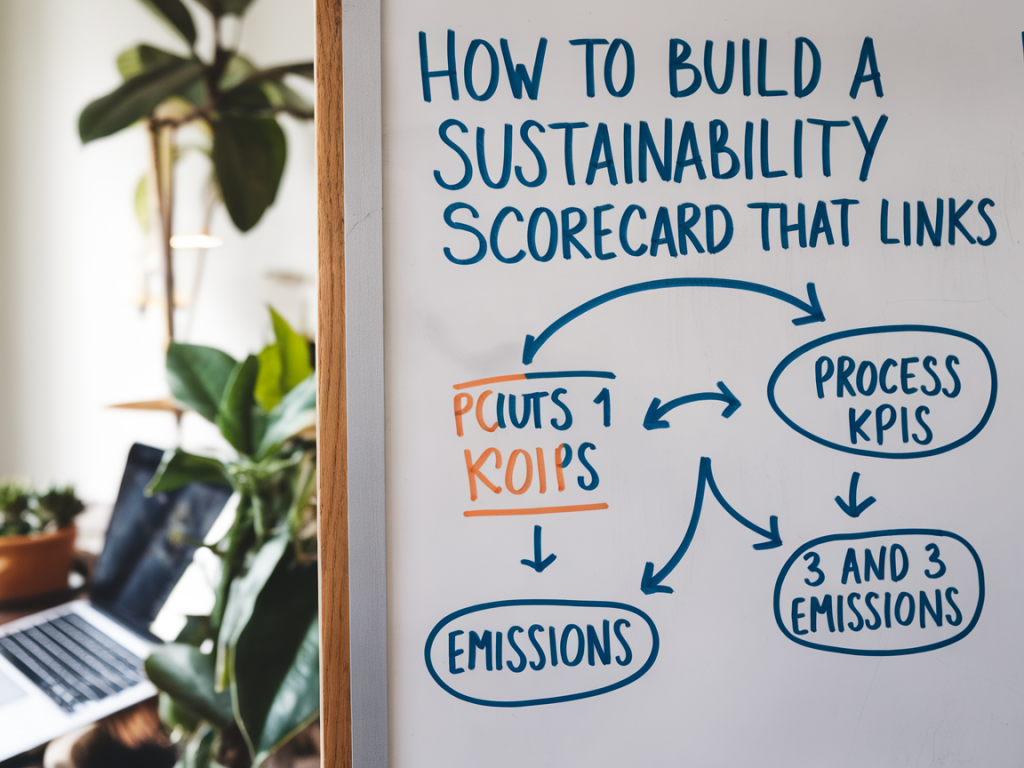
I often get asked how to make sustainability more than a reporting checkbox — how to turn environmental targets into operational levers that plant managers, engineers and procurement teams can act on day‑to‑day. A sustainability scorecard that explicitly links process KPIs to Scope 1 and Scope 3 emissions is one of the most practical bridges between executive goals and shop‑floor decisions. Below I walk through the approach I use in client projects: what to measure, how to map process data to emissions, which tools and data sources matter, and how to present a scorecard that drives change.
Start with the decision you want to influence
Before choosing KPIs or emission factors, I ask stakeholders two questions: what decisions will change if emissions are visible at process level? and who needs to act on them? If the decision is to reduce furnace fuel use, the scorecard needs to show fuel consumption per heat‑treatment batch and the related Scope 1 CO2e. If the decision is to reduce upstream plastic inflows, the scorecard must link material yield, scrap rate and supplier transport to Scope 3 emissions.
This focus avoids an “everything and nothing” dashboard and makes the scorecard prescriptive: it surfaces metrics tied to behavior (operator setup, maintenance cadence, procurement choices) rather than just high‑level totals.
Define process KPIs that map to emission sources
My rule of thumb is: pick KPIs that are measured (or can be measured) reliably in operations and have a clear causal link to emissions. Examples I frequently use:
- Energy intensity (kWh per part or per batch) — directly maps to Scope 1 (onsite combustion) or Scope 2 (purchased electricity) depending on source.
- Fuel consumption (m3 gas, liters diesel per shift) — Scope 1, straightforward to convert to CO2e using fuel‑specific factors.
- Yield / First Pass Yield (FPY) — lower scrap reduces embodied emissions in Scope 3 (purchased goods & upstream materials).
- Downtime and throughput variance — causes inefficient runs, overtime, and rework that amplify energy and material intensity.
- Material consumption per product (kg raw material/finished unit) — maps to Scope 3 embodied emissions including supplier manufacturing and transport if you have supplier LCA data.
- Transport KPIs (ton‑km per order) — map to Scope 3 logistics emissions using mode‑specific emission factors.
Map each KPI to an emissions pathway
For each KPI identify whether its emissions fall under Scope 1, 2 or 3 and the transformation needed to turn the KPI into CO2e. I create a simple mapping table you can embed in the scorecard; here’s a condensed example structure I use in projects:
| Process KPI | Emission Scope | Calculation approach | Typical data sources |
|---|---|---|---|
| Energy intensity (kWh/part) | Scope 2 (electricity) / Scope 1 (onsite gen) | kWh × grid factor (kgCO2e/kWh) | Sub‑metering, Building Management System (BMS), utility bills |
| Fuel liters per shift | Scope 1 | liters × fuel CO2e factor (kgCO2e/liter) | Fuel invoices, tank meters, PLC counters |
| Material kg/part | Scope 3 (purchased goods) | kg × supplier LCA factor (kgCO2e/kg) or industry average | ERP BOM, supplier datasheets, Ecoinvent |
| Transport ton‑km/order | Scope 3 (logistics) | ton‑km × mode factor (kgCO2e/ton‑km) | WMS/TMS, freight invoices |
Choose emission factors and maintain provenance
Choosing emission factors is where projects often stumble. I use a hierarchy of sources:
- Company or supplier‑specific LCA data (best)
- National grid factors for electricity (e.g., IEA, local regulator)
- Industry LCI datasets (Ecoinvent, GaBi) for materials
- GHG Protocol and DEFRA factors for fuels and transport
Always record the version, source and date of factors in the scorecard metadata so future audits or updates are traceable. When supplier data is unavailable, use conservative industry averages and flag the assumptions on the scorecard.
Data architecture: where to get the numbers
Practical scorecards rely on a mix of automated and manual data sources. My preferred stack includes:
- Industrial automation (PLCs, OPC UA) and MES for production counts, cycle times, equipment statuses and energy sub‑metering.
- Building management systems or IoT energy meters for site energy and fuel measurement.
- ERP and MRP for BOMs, purchase orders, and supplier information to estimate embodied emissions.
- TMS/WMS for logistics and transport KPIs.
- Data warehouse or IIoT platform (Azure, AWS, or on‑prem historian) to aggregate and timestamp metrics.
I advise starting with the most reliable automated feeds (energy meters, production counts) and collecting missing data manually during the pilot phase. Manual inputs should be time‑stamped and linked to a source owner to avoid data quality issues.
Transformation layer: KPIs -> CO2e
Build a small transformation layer that applies emission factors to KPIs. This can be done in a BI tool (Power BI, Tableau), in a cloud function, or in the data warehouse. Key capabilities the transformation needs:
- Unit conversions (liters to kg, kWh to MJ).
- Mapping tables for product BOMs to allocate embodied emissions across assemblies.
- Temporal alignment (aligning hourly energy to hourly production counts).
- Scenario toggles (e.g., swap supplier factor, change grid factor for hypothetical renewables).
Design the scorecard for action
Visibility alone won’t change behavior. I design scorecards with these principles:
- Line of sight: Each KPI card shows the KPI value, the calculated CO2e, the target, and the recommended action (e.g., adjust setpoint, schedule preventive maintenance, source alternative material).
- Attribution: Break totals down by process area, product family, and supplier so owners can be identified.
- Drilldowns: Operators should be able to drill from a plant‑level energy intensity number to machine‑level runs and the specific shifts or recipes driving the variance.
- Confidence and assumptions: Surface a confidence score (high/medium/low) for each KPI→CO2e mapping depending on source data quality.
Pilot, iterate, expand
I rarely deploy a full enterprise scorecard in one go. My typical rollout is:
- Pilot one process line where the emissions are significant and data is available (e.g., injection molding or heat treatment).
- Validate the KPI→CO2e calculations with ground truth (utility invoices, lab LCA data from a supplier).
- Run the pilot for at least one product cycle to capture seasonal or batch variability.
- Refine factors, add automation for missing measurements, and create action playbooks tied to each KPI alert.
- Scale to other lines and incorporate upstream supplier data to improve Scope 3 coverage.
Governance, incentives and cross‑functional ownership
To make a scorecard stick you need a governance model: a clear owner for each metric, a review cadence (weekly operations reviews, monthly sustainability board), and incentives. I’ve seen plants tie small bonuses or recognition to measured reductions in energy intensity or scrap‑related Scope 3 emissions. Importantly, IT/OT, procurement and sustainability teams must agree on data responsibilities and update procedures for emission factors.
Examples of actionable metrics and recommended operational responses
- Energy intensity spike on Line A: Check recipe change, verify sub‑metering, confirm whether the chiller is overloaded — short term: adjust loading; medium term: optimize sequencing.
- Rising material consumption per part: Investigate tooling wear, raw material variability or incorrect BOM usage — implement corrective maintenance and supplier QA.
- High transport ton‑km: Consolidate shipments, switch to rail where feasible, or renegotiate supplier delivery cadence.
Tools and practical references
I use a combination of off‑the‑shelf and custom components depending on the client's maturity:
- MES + sub‑metering for reliable shop‑floor KPIs.
- Power BI or Grafana for scorecards and drilldowns.
- Data warehouse (Azure Synapse, AWS Redshift) or a lightweight Postgres for the transformation layer.
- LCA datasets: Ecoinvent, GaBi, or supplier LCAs for product‑level Scope 3.
- Reference frameworks: GHG Protocol, ISO 14064, DEFRA emission factors.
Building a sustainability scorecard that links process KPIs to Scope 1 and 3 emissions is as much about organizational clarity and repeatable data flows as it is about the math. When you prioritize decision‑centric KPIs, establish a transparent mapping to emission factors, and present insights in an actionable format, you convert sustainability targets into day‑to‑day operational improvements that cut cost, waste and carbon simultaneously.