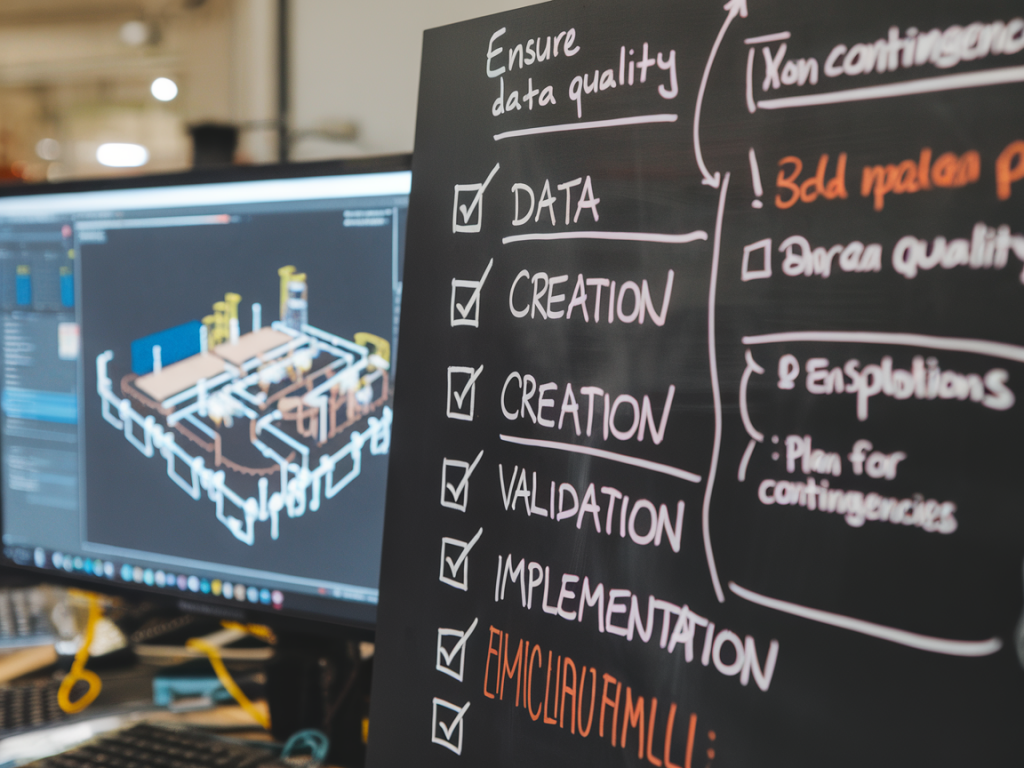
I recently led a brownfield digital twin project on a live assembly line and learned that the difference between a disruptive mess and a smooth, measurable upgrade is largely down to planning, staged delivery, and respect for the plant’s rhythms. Below is the step‑by‑step checklist I use to build a digital twin for a brownfield assembly line with minimal downtime. It’s practical, tested across automotive and electronics lines, and suitable whether you plan to use Siemens Digital Industries Suite, PTC ThingWorx, AVEVA, or an open stack with Ignition and Kafka.
Clarify intent and success criteria
Before touching cables or writing a single model, I define the why. A digital twin can do many things — throughput prediction, root‑cause analysis, what‑if planning, predictive maintenance — but you must pick a primary use case.
Document these in a one‑page charter and get sign‑off. This avoids scope creep that would force risky changes on the live line.
Map the current state (non‑invasive discovery)
I treat the existing line as a living organism. Walk it, talk to operators, review PLC code, and map data flows. The goal is a low‑risk data model that reflects reality.
Capture this in a simple diagram (drawn in Visio, Lucidchart or PlantUML). I include notes about which PLCs support OPC UA or need protocol gateways.
Design a minimal, incremental architecture
For brownfield projects I favour a hybrid architecture: keep critical control on the PLCs and mirror state to an adjacent OT‑read zone. This minimizes risk and downtime.
Prioritize non‑intrusive data collection
My absolute rule: never change PLC logic during first integration. Read only. The easiest wins come from tapping existing signals.
Build a shadow model and validate offline
I create a "shadow twin" that runs in parallel without influencing the line. This is where you validate data mappings, model fidelity and prediction logic.
Pilot on a single cell — fast, observable, reversible
The pilot cell should be small, representative, and accessible. My pilots last 2–6 weeks and focus on closed feedback loops that don’t affect control sequences.
Operationalize model updates and governance
Once the pilot proves value, establish how the twin will be maintained and evolved.
Rollout plan with staged cutover
Rollout is a sequence of low‑risk steps, each with acceptance gates.
KPIs, dashboards and operator workflows
To be adopted, a twin must fit operator cadence. I design dashboards for 1) operators, 2) supervisors, and 3) engineers.
| Audience | Core View | Action |
|---|---|---|
| Operators | Current station state, next part ETA, simple recommendations | Adjust feeder, expedite part supply |
| Supervisors | Line throughput, bottleneck alerts, predicted delays | Shift reallocation, preventive maintenance flag |
| Engineers | Model diagnostics, residuals, sensor health | Tune model, schedule sensors retrofit |
Safety, cybersecurity and compliance
I enforce three musts:
For cybersecurity, follow IEC 62443 principles; for data privacy, align with corporate and regional rules (GDPR if EU). I’ve used Palo Alto firewalls and Fortinet appliances for OT segmentation with success.
Common pitfalls and how I avoid them
Roles, timeline and responsibility matrix
| Role | Responsibility | Typical time allocation |
|---|---|---|
| Project lead (me) | Scope, stakeholder alignment, delivery | 20% |
| OT engineer | PLC tag mapping, gateway config | 40% |
| Data engineer | ETL, historian, API | 40% |
| Modeler/Analyst | Build & validate twin | 50% |
| Operations rep | Acceptance testing, feedback | 15% |
Typical timeline for a single line pilot to staged rollout: 8–12 weeks for pilot, 12–24 weeks to full roll‑out depending on complexity and sensor retrofits.
This checklist is what I use at Ccsdualsnap Co (https://www.ccsdualsnap.co.uk) to guide brownfield digital twin work that delivers real ROI without disrupting production. If you want, I can share a template charter, a minimal tag list, or a pilot acceptance checklist tailored to your line — tell me about the equipment and protocols you have and I’ll adapt it.